 VitaCollecta
A whole world to collect.
Set off on expeditions to real regions of the world and collect their animals and plants, as cards. Free, no ads, no purchases.

Diego Delso · CC BY 3.0

Jean Beaufort · CC0

Bernard Gagnon · CC BY 4.0
Photos: Diego Delso · CC BY 3.0 (koala); Jean Beaufort · CC0 (grizzly bear); Bernard Gagnon · CC BY 4.0 (tiger)


992 real species · 14 regions of the world · free, credited photos
Vitacollecta is now in English! Code EXCUSEMYENGLISH: 100 shells and the Alfred Russel Wallace collector card (200 numbered copies), until 31 December. Sign up
Code EXCUSEMYENGLISH: 100 shells and the Alfred Russel Wallace collector card (200 numbered copies), until 31 December. Sign up
For families
Under 15, a parent creates their child's account from their own, and approves the child's friends. Until 18, no free text between players (ready-made phrases instead), and rankings only under an animal nickname. No ads, no purchases: cards are earned by playing, never by paying.
For naturalists
992 real species with their scientific name, seasons, migrations and relationships, based on Wikipedia, Wikidata, GBIF and iNaturalist; freely licensed photos from Wikimedia Commons, credited. Spotted a mistake? Every card has a button to report it.
Three cards from the game
As they appear in the album: a common species, a rare one and an exceptional one, each with its photo, its habitat and its habits.
 VitaCollectaCommon

Phascolarctos cinereus
It sleeps up to 20 hours a day in the eucalyptus trees.
Diego Delso · CC BY 3.0
Photo: Diego Delso · CC BY 3.0
VitaCollectaRare
Ursus arctos horribilis
The great brown bear of the Rockies, recognisable by its hump.
Its front claws, as long as fingers, are used for digging up roots and marmots.
Jean Beaufort · CC0
Photo: Jean Beaufort · CC0
VitaCollectaExceptional
Panthera tigris
The largest of the cats, striped to blend into the tall grass.
A tiger's stripes are unique, like a fingerprint: India's tigers are counted with camera traps.
Bernard Gagnon · CC BY 4.0
Photo: Bernard Gagnon · CC BY 4.0
A card earns its stars when you meet the species again: the first encounter, the anecdote and the season, the full fact sheet on the back.
A game in four steps
Set off on an expedition
Choose a region, a habitat and your equipment. The weather, the season and the local time decide what you will meet.
Discover a species
When you return, your field notebook reveals your observations: often familiar faces, sometimes a species never seen before.
Earn its card
Each new species becomes a card, with its real photo. Duplicates upgrade it or can be traded with friends.
Complete the album
The album fills up habitat by habitat. Each level opens new tools, habitats and regions.
… and off you go again, towards the missing card.
The game in pictures
Screenshots taken from the French version of the game: the English version looks the same.
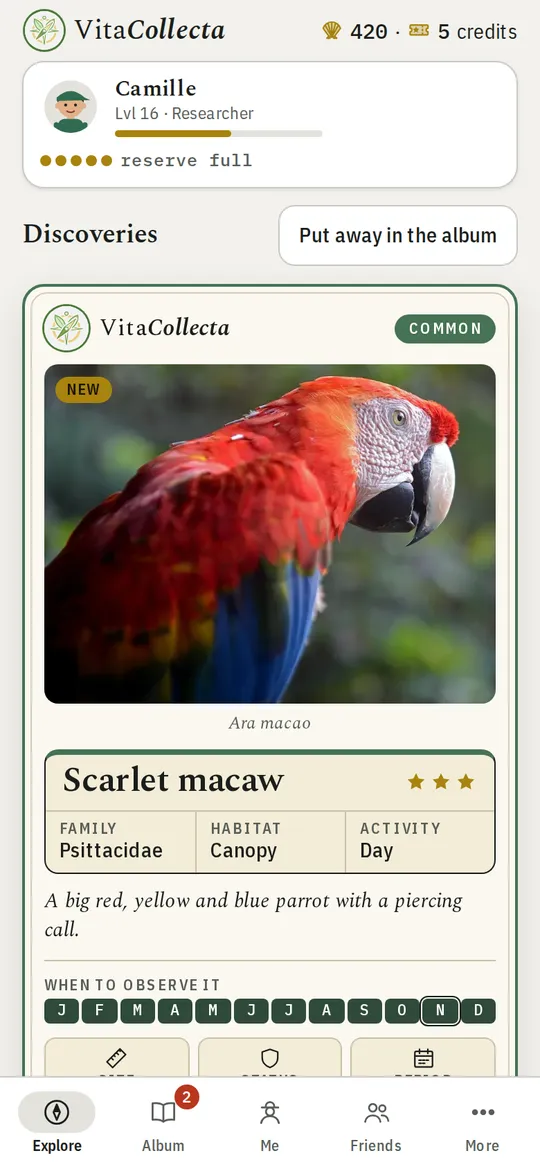
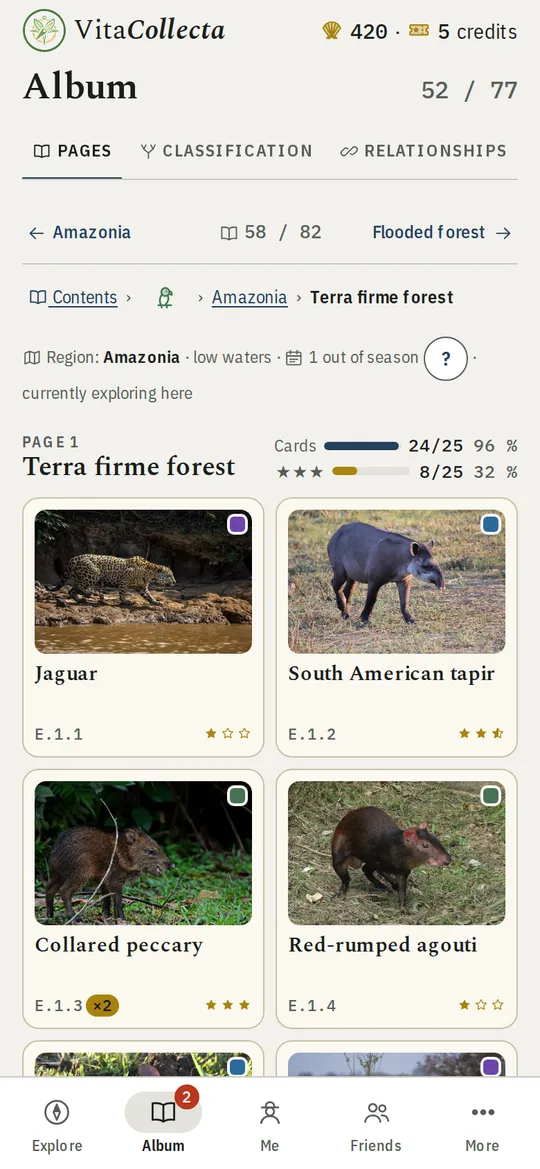
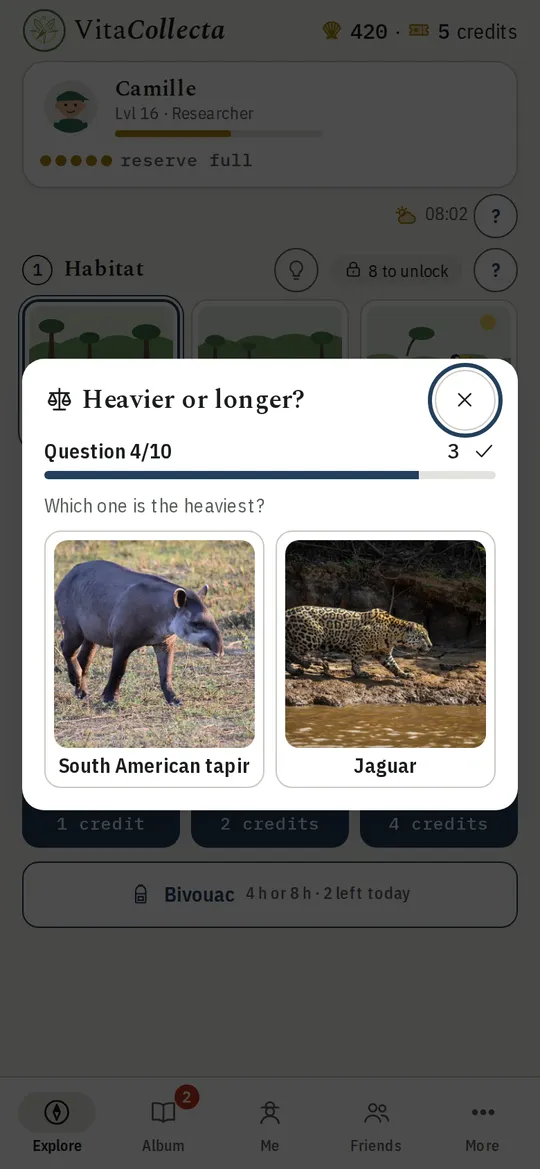
Learning without noticing
No lessons, no homework: what you learn comes with the cards, discovery after discovery.
- Did you know?An anecdote on every card: the nutcracker that hides 30,000 seeds a year, the manakin that moonwalks…
- Who eats whomLinks between species are revealed: prey, predators, flowers and pollinators.
- Quizzes and mini-gamesAbout the species you have already seen: “Heavier”, the right habitat, memory… in a duel with a friend if you like.
- Real natureSeasons, migrations, night animals, threat status: the cards follow the naturalists' data.
And with friends
- Trade, giveOffer your duplicates, give a card, follow your friends' albums.
- Set off togetherTeam expeditions, auctions, mentoring of newcomers and rankings, if you wish.
14 regions to explore
- Atlantic coasts and hedgerows
- East African savannah
- Rocky Mountains and conifer forests
- Mediterranean
- Amazonia
- Australian outback and bush
- India and monsoon forests
- Antarctica and sub-Antarctic islands
- Eastern temperate forests
- Sahara and Sahel
- Southeast Asian jungle
- Northern European taiga and tundra
- Alps and mountains of Europe
- Andes
- More to come
Our principles
- Free, with no ads or trackers.
- No paying for cards and no paid draws: everything is earned by playing.
- Freely licensed photos (Wikimedia Commons), credited to their authors; texts written for the game.
- A small community in beta: open sign-up by e-mail, or by invitation from a friend.
- A non-profit vocation: in the medium term, the game will be handed over to a non-profit association, so that it remains a common good.
Frequently asked questions
Is the game available in English?
Yes: cards, menus and help are in English. The texts were written in French and translated with the help of an AI, then checked by sample: if a sentence reads oddly, tell us. An account created from this page plays in English; the language can be changed in the settings.
Is the game really free?
Yes: no ads, no in-app purchases, no subscription. Cards, shells and equipment are earned by playing.
What device can I play on?
In the browser, on a phone, tablet or computer, with nothing to download. On a phone, the game can be installed on the home screen like an app.
Are the species real?
All of them: 992 species from 14 regions of the world, with their scientific name, their seasons and their measurements, based on Wikipedia, Wikidata, GBIF and iNaturalist. The photos are freely licensed and credited to their authors.
Who is behind Vitacollecta?
Nicolas Gripon, in Cherbourg-en-Cotentin (France), who develops the game personally and on a non-commercial basis. In the medium term, the project is meant to become a non-profit association. See the legal notice.
Join the beta
What you can do
The whole game, for free: all 14 regions of the world to open by playing, the album, the mini-games and friends. Your game follows your account, on your phone as on your computer.
What we ask of you
Play at your own pace, and tell us what goes wrong: a bug, a mistake on a card (each card has its “Report” button), a sentence that reads oddly in English, an idea. Nothing compulsory.
How to sign up
Enter your address: you will receive an e-mail with your sign-up link straight away. A friend already plays? Ask them for a code instead: you will be friends straight away.